Motors, Control Options Advance Robotic Opportunities
by Bill Schweber, Mouser Electronics
Featured Products
Featured Suppliers
Related Resources
Most are aware of the classic robot of science fiction, but the real growth in robots is in self- and remotely
guided machines. These robots perform specific, well-defined tasks like assembly-line work, surgical assistance,
warehouse delivery/retrieval, and even dangerous tasks such as clearing mines. Today's robots can handle both
highly repetitive tasks as well as complex functions requiring flexibility in orientation and action (Figure 1).
Figure 1: Robotics are now routinely used in applications
ranging from small pick-and-place machines to large auto assembly lines where they lift, place, install, and
even weld parts and subassemblies. (Source: IStockPhoto.com)
These high-performance machines are possible due to several advances: the sensors that help them hear, see, and
feel; the computational power and sophisticated algorithms that enable real-time decisions and actions; and the
motors that implement these decisions with speed, accuracy, and mechanical power. Each plays a vital role in
robot design, because technological advances and the synergy among them rapidly builds on itself.
Traditionally, managing the motor has been a challenge for electronic engineers, since many critical issues are
so different from those in the more-familiar electronics. Fortunately, technology has made these issues more
understandable and easier to deal with, while also enabling impressive performance. For instance, Texas Instruments' DRV8816 dual
half-bridge motor driver has integrated internal protection functions including short-to-ground protection,
overtemperature warning, and overtemperature shutdown. A low-power sleep mode shuts down internal circuitry to
achieve very-low quiescent current draw. Highly integrated controllers and drivers point to the level of
flexibility and integration that electronics and motors have achieved.
Start with Motor Choices
There are three primary parameters that designers consider when selecting a specific motor type and model:
- The minimum and maximum motor speed (and associated acceleration);
- The maximum torque the motor can deliver, and the torque vs. speed curve;
- The precision and repeatability of the motor's operation (without using a sensor and closed-loop control).
Of course, there are many other performance factors involved in motor selection, plus size, weight, and cost
factors. For nearly all small-to-moderate-sized robotic actuators, the most common choices for powering the
actuator are the brushed DC, brushless DC (BLDC), and stepper motors. (However, there are some cases in which
pneumatics and hydraulics are the best choice; see sidebar "Go with fluid power?".)
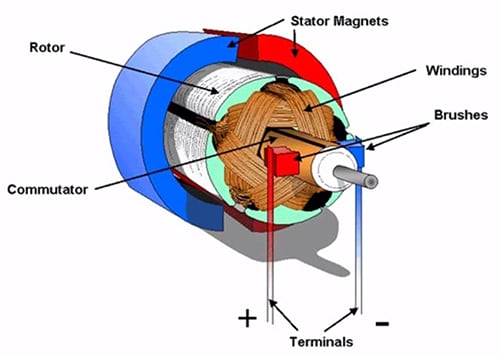
Brushed motors, the oldest DC-motor technology, are the simplest and least-expensive choice (Figure 2). The
rotation of the motor's rotor switches (commutates) the field of the windings around the rotor via
current-carrying brushes that make contact with the rotor. The motor speed is a function of the applied voltage,
so the drive requirements are minimal, but managing the torque and associated position is difficult. They also
have reliability issues due to the brush wear-out, may need maintenance as the brushes and their springs need
cleaning, and are a source of electrical noise (EMI) due to the sparking at the contact point between the brush
and rotor contacts as the rotor turns. For these reasons, brushed-DC motors are the least-attractive choice for
robotics in most cases.
Brushless motors (Figure 3) became practical beginning in the 1960s due to two developments: strong, small,
low-cost permanent magnets, and small, efficient electronic switches (usually MOSFETs, but sometimes bipolar
transistors with low-voltage drop) to toggle the current flow to the windings. The interaction between the
stationary surrounding switched coils and the magnets on the rotating core replaces the mechanical commutation
of the brushed motor with electronic commutation. The magnetic field of the coils is switched by turning the
MOSFETs (usually configured in an H-bridge arrangement) on and off in a precisely timed sequence. By changing
the frequency at which these MOSFETs are switched, the motor speed is controlled. In addition, the motor
controller can sense the rotor position via a transducer, and as such, has tighter control over motor
performance.
Even better, advanced algorithms such as PID (proportional-integral-derivative) or FOC (field-oriented control,
sometimes called vector control) can be embedded in the motor controller. This matches the desired motor
operation to the reality of the load and load changes, to provide enhanced performance. These algorithms can
take into account factors such as the rotor's inertia, and adapt the motor drive to errors due to mechanical
issues such as backlash or other sources. Using such algorithms provides the opportunity for precise control of
acceleration and torque profile, in addition to speed setting.
Compared to brushed motors, brushless motors need more complicated control electronics but can deliver far better
performance. BLDC motors usually require a feedback sensor, via Hall Effect devices, optical encoders, or
sensing of back EMF. (Note that it is also possible to achieve some advanced control with traditional brushed
motors by having a sensor for feedback, but their inherent design and electromechanical issues still limit their
performance.)
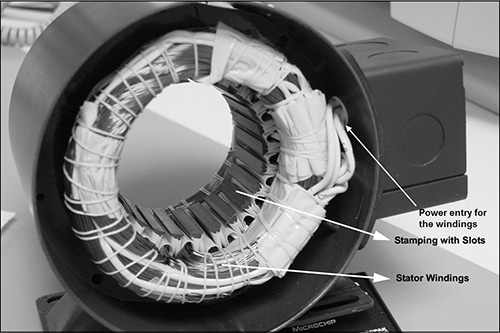
Another brushless alternative is the stepper motor (Figure 4), which uses switched electromagnets arranged around
a central core that is arrayed with a ring of permanent magnets. Step angles typically range from about 1.8â°
(200 steps/rev) to 30â° (12 steps/rev), depending on the number of permanent magnets, but higher and lower
values are available.
Figure 4: The stepper motor uses a ring of electromagnetic
poles around a core with permanent magnets; by energizing these poles in sequence, the rotor is forced to
turn. (Source: Microchip
Webinar)
Steppers do not rotate in the normal sense; instead, the shaft is directed to move in finite, step-by-step
increments and so can be directed to turn just a fraction of a complete revolution as well as to rotate
continuously. If power is maintained but no stepping is directed, they will hold their position; steppers can
provide high torque at low rpm. The most direct way to cause the stepper to move is to turn the electromagnets
on or off in sequence, but this can cause chattering or vibration. To avoid this problem in situations where it
is not acceptable, some advanced controllers support microstepping, where nearby windings are also energized in
such a way that the stepping motion is smoother and more continuous than simple on/off control supports.
There is application overlap between BLDC and stepper motors. Steppers are better suited for applications that
require precise back-and-forth motion, such as pick and place, rather than continuous rotation for long periods,
and for smaller applications that don't require the motor to provide high torque or speed. Also, steppers are
not as energy-efficient as brushless-DC motors.
There are many other motor options, as well. The family genealogy tree for motors is long and complex, with many
siblings and cousins. For example, the permanent-magnet synchronous motor (PMSM) is a combination of a
brushless-DC motor (with respect to the rotor) and an AC-induction motor (with respect to stator structure). It
features high-efficiency, relatively high power in a small package, a high torque/weight ratio, fast-response
times, and is fairly easy to control, but can be costly.
Control Requires Finesse
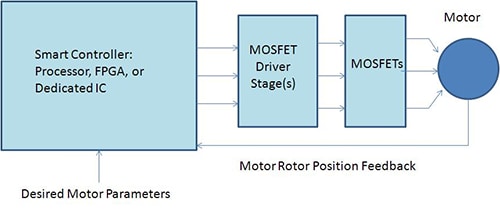
A motor alone, even with basic control of motor current, is not a robotics motion system, which consists of three
major functional blocks (Figure 5):
- The real-time controller, which can be implemented in one of three ways: in a general-purpose,
computationally fast processor running motion-control firmware; a DSP-oriented FPGA programmed for the
control application; or via a dedicated controller IC with hard-wired, embedded algorithms.
- One or more driver stages in series, to take the low-level signals from the controller output and interface
them to the higher-voltage/current needs of the electronic switches.
- The MOSFETs (or other switching element such as IGBT or bipolar transistor), which actually control the flow
of current to the motor windings.
When selecting components, the choice of specific MOSEFT is determined primarily by the required current and
voltage demands of the motor and its windings. While there are thousands of MOSFETS to choose from, the choice
is driven almost entirely by these motor ratings (and cost, of course).
Once the MOSFET is selected, the choice of driver is determined by the rating of that MOSFET; if it is large, a
series of step-up drivers may be needed depending on the MOSFET size. As with the MOSFETs themselves, the driver
choice is largely determined by how much drive current and voltage the MOSEFT itself needs to be turned on and
off. (Note there is some ambiguity and overlap in terminology, so check the data sheet description carefully: a
"driver" can be the block that drives the MOSFET, or it can be the MOSFET that "drives" the motor coils.
Further, some "driver" ICs includes both the MOSFETs and their drivers on the same die.)
In contrast to the MOSFET or driver selection, deciding which controller type to use is a strategic choice, and
must be made before selecting a specific vendor or model. This is because there are many trade-offs when
deciding to use a general-purpose programmable processor that is well-suited for motor control, a
computation-friendly FPGA, or a dedicated control IC (the latter is most often from a specialized motion-control
vendor). Some of the points designers must consider include:
- What level of control algorithm sophistication and complexity do you need, and how much I/O? For example,
FOC demands multiple, concurrent calculations involving complex transformations and thus advanced functional
blocks (Figure 6).
Figure 6: An advanced motor-control approach such as
field-oriented control requires multiple numerical transforms and both a fast inner loop and a slower
outer loop. (Source: Altera)
- If using a general-purpose programmable IC or FPGA, who provides the control algorithms and code: the IC
vendor, a third party partnering with them, or an unrelated third party? How are they verified and tested
for your motor and application?
- If using a dedicated, pre-programmed control IC, does it offer the range of functions and features needed?
- How much user-programmability do you need or want? Even dedicated, non-programmable controllers allow users
to select algorithm type, closed-loop control mode (position, velocity, acceleration), and set operating
parameters such as time constants or allowable error band.
- Will there be a need to adjust or modify the basic algorithm, or do the motor and application have unique
attributes? If so, a programmable IC might be better. On the contrary, is there a concern that there will be
constant requests to modify the algorithm? In this case, a dedicated IC with hard-wired embedded algorithms
may be better than a fully programmable one.
- Does the controller have to support one motor type or multiple types? Even if just one type, is it one motor
size of that type, or a range of sizes?
- To what level does the vendor provide technical support? What is their actual, hands-on motor experience? Do
they provide detailed reference designs that have been built and tested, including the interface between the
control IC and MOSFET drivers?
- Are there regulatory issues to be aware of, such as mandated efficiency (many motor applications must now
meet various "green" standards)? If so, does the vendor understand and meet them, in their components and
algorithms?
Chip and Board Examples Show Controller, Interface Capabilities
For many engineers, pulling all the parts together - the controller with embedded or separate algorithms, the
drivers, and the MOSFETs - is a multidisciplinary task, and one for which they don't want to "reinvent the
wheel." For this reason, many vendors of motor-control ICs provide evaluation boards and even complete shippable
boards that include controller, algorithms, drivers, and MOSFETs.
For example, the 1240i from Applied Motion
Products is a programmable step-motor driver, suitable for a wide range of motion-control applications
(Figure 7). It includes a sophisticated controller integrated with a 50-watt microstepping amplifier and
connects directly to the stepper motor, providing programmable motor current of up to 1.2 amps/phase and speeds
to 50 rev/sec.
Figure 7: The 1240i Programmable Step-Motor Driver from
Applied Motion Products is a complete motion-control package, and can be directed from a PC in the end
application, or used as a self-contained, standalone controller after setup. (Source: Applied Motion Products)
Different variations are available to handle the many standard stepper versions and interfaces in use. The board
can be programmed by user via the vendor's motion control toolkit and a standard PC to be a standalone motion
controller. It can also be commanded in real time from a host PC or programmable logic controller (PLC).
Robotics has an exciting future ahead. Sensing, control, and motors are key areas where innovation will continue
to shape how robots evolve as innovation in technology continues to unfold.
Sidebar: Go with Fluid Power?
Using compressed fluids is an alternative to electric motors for robotic motion. This can take two forms:
oil-based hydraulics and air-based pneumatics. Hydraulic-based power has a long history in applications that
need significant amounts of power, such as earth-moving equipment, and was used in early auto-assembly-line
robotics because it was well understood, with a long history. However, a hydraulic actuator needs careful
integration of the electronic-control functions with the hydraulic design and components, as well as a
compressor/pump in addition to the electrical-power supply. Further, the inevitable problems of seals leaking,
complexities of maintenance (electrical and hydraulic technicians are needed), and the environmental
consequences of leaks and spills make it a choice only when there is no viable alternative, or when sensitivity
to electrical noise (EMI/RFI) is a concern.
Some lower-power applications use compressed air, especially if EMI/RFI and ESD are concerns. Air-based systems
do not have the potential problems of hydraulic fluid, but they cannot provide as much power in a given volume,
so the supply lines needed for the compressed air are relatively bulky. Like hydraulic-based motion, pneumatic
systems can leak, are hard to troubleshoot, and require multidisciplinary knowledge to design, install, and
maintain. They can be a viable option for basic, rapid, back-and-forth motion, however.
Due to the dramatic improvements in high-power electric motors and their controls, many applications that
previously used hydraulics have switched over, unless there are otherwise compelling technical reasons to stay
with hydraulics. For new designs, especially in small-to-medium robotic situations (and even many of the larger
ones), the first choice is to go with electronic controls and electric motors. This does not mean that hydraulic
systems are obsolete, as there is a need for hydraulics and pneumatics for high-rate, high-impact, high-power
bursts. Examples are the ram of metal forging stations (hydraulic) and the launch catapult for aircraft carriers
(steam and air).
 Bill Schweber is an electronics engineer who
has written three textbooks on electronic communications systems, as well as hundreds of technical articles,
opinion columns, and product features. In past roles, he worked as a technical web-site manager for multiple
topic-specific sites for EE Times, as well as both the Executive Editor and Analog Editor at EDN.
Bill Schweber is an electronics engineer who
has written three textbooks on electronic communications systems, as well as hundreds of technical articles,
opinion columns, and product features. In past roles, he worked as a technical web-site manager for multiple
topic-specific sites for EE Times, as well as both the Executive Editor and Analog Editor at EDN.
At
Analog Devices, Inc. (a leading vendor of analog and mixed-signal ICs), Bill was in marketing communications
(public relations); as a result, he has been on both sides of the technical PR function, presenting company
products, stories, and messages to the media and also as the recipient of these.
Prior to the MarCom
role at Analog, Bill was associate editor of their respected technical journal, and also worked in their product
marketing and applications engineering groups. Before those roles, Bill was at Instron Corp., doing hands-on
analog- and power-circuit design and systems integration for materials-testing machine controls.
He
has an MSEE (Univ. of Mass) and BSEE (Columbia Univ.), is a Registered Professional Engineer, and holds an
Advanced Class amateur radio license. Bill has also planned, written, and presented on-line courses on a variety
of engineering topics, including MOSFET basics, ADC selection, and driving LEDs.