AI and Creativity
Can AI Create Truly Original Art?
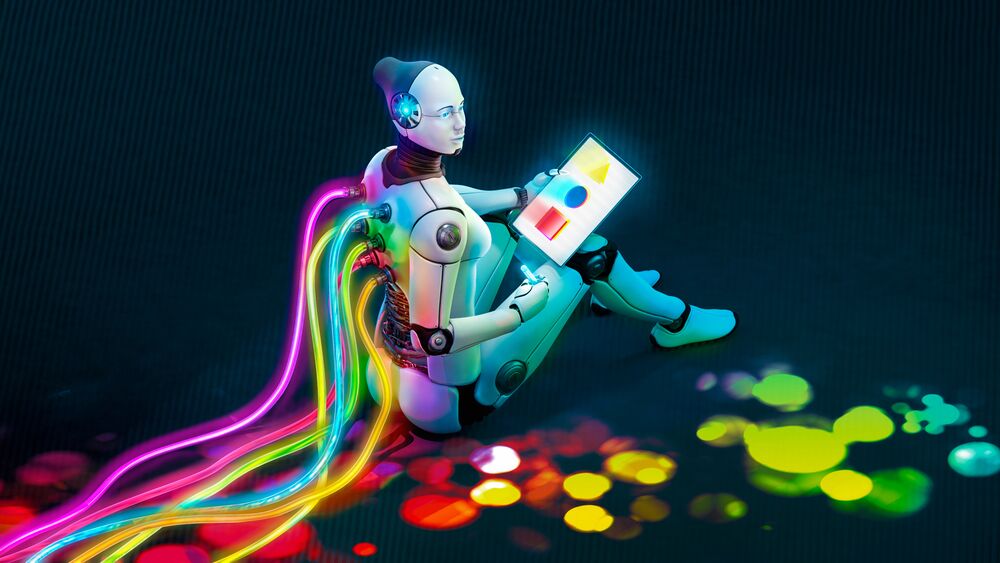
Image Source:
Marcos Silva/Stock.adobe.com
By Becks Simpson for Mouser Electronics
Published December 27, 2022
It seems like every other day a new, highly powerful artificial intelligence (AI) model is released that can
produce extremely impressive content that rivals the work of human artists. All of the creative fields, from
visual
arts and literature to music and video, are being disrupted with models like DALL-E, Stable Diffusion, and GPT-3
(Generative Pre-trained Transformer 3). As these AI models win competitions and produce artworks that sell in
auctions for half a million dollars and are often easily mistaken for works done by their human counterparts,
the
question of whether AI can really create truly original art arises: Is AI genuinely creative? That question
itself
opens a can of worms that leads to deeper thoughts about what constitutes originality and creativity in the
first
place and whether something needs either of those to be considered art. Further down the rabbit hole, the
notions of
what can and should be considered art are thrown into debate. By virtue of how AI models are trained using reams
of
past data, human outputs, and history, to say they are creating truly original works might be a stretch, but the
way
that elements are combined and produced could be considered creative depending on the definition of creativity.
However, despite that uncertainty, given the popularity of these models for producing new visual art,
literature,
and music, creativity and originality are seemingly no longer prerequisites for creating art. Some argue that
without a human element of intent and imbued meaning, AI-generated art is not true art, while others state that
since human input is still needed, art created by an AI model is genuine.
Art = Creativity; Creativity = Originality, but Is It That Simple?
Ask almost anyone or run a quick Google search: Creativity is often paired directly with originality. Creativity
is
seen as the act of using imagination to create totally new ideas, typically of artistic expression, that produce
novel and unique interpretations. To be creative, one must likely develop previously unseen concepts and outputs
for
something to be considered art. People primarily opt out of creating art owing to this notion that originality
is
supposed to go hand-in-hand with creativity; their ideas aren’t “creative” because
they’ve
emerged before. However, psychology has uncovered three kinds of creativity: Exploratory, transformational, and
combinatorial (Ness Labs).
Exploratory creativity involves trying new things within a given set of rules, while transformational creativity
involves the creation of new rules (or even ignoring certain rules) within the genre to generate seemingly
impossible, but highly creative, new ideas. Most novelists engage in exploratory creativity, while the Cubists,
for
example, were at least in part transformational. Combinatorial creativity, however, involves combining existing
ideas, motifs, and elements in unexpected and interesting ways. While people most often think of exploratory and
transformational creativity as the pinnacle of artistic expression, it is combinatorial creativity which
actually
produces most new ideas. Of course, most great art was created through a combination of the three. Even among
the
transformational artists, influence/combination was a vital element to their creativity.
The debate around creativity and originality aside, another important piece to consider when it comes to defining
art is the role of intent and awareness of meaning. Art is supposed to convey something from within the
artist—perspectives, emotions, or worldview—and create a connection with the experiencer, who then
interprets those elements. The interplay between the artist and the experiencer can be complex, too.
Experiencers of
art can interpret things differently than the artist intended, including identifying meaning in elements that
weren’t meant to carry any. Conversely, the deep meaning imbued in a work of art can also be totally
overlooked or misunderstood by the experiencer. In cases where the artist’s or author’s original
intent
cannot be identified (e.g., because the person has passed away), the only meaning left is whatever the
experiencer
discovers. All of these points muddy the water when determining whether AI can truly create art.
How Close Does AI Come to Achieving Creativity and Originality?
In terms of pure originality, arguing that AI is making anything truly unique and novel is more difficult because
AI literally is building on the shoulders of giants. “Originality is undetected
plagiarism,”
said author William Inge. Given that all of these impressive new models are typically trained on vast swaths of
publicly available data from existing artworks to classic literature, these influences almost certainly will
leak
through in some way, even if it’s not obvious. For example, the State Fair–winning entry by
Midjourney
is said to be reminiscent of Gustave Moreau, a late 19th–century artist associated with the Decadents, who
influenced Edgar Degas and Henri Matisse (Washington Post). Additionally, the human intervention usually
required in
the form of a prompt is also a limiting factor on the originality that AI could demonstrate. In cases where the
prompt is highly detailed, most of the originality comes from a human with the initial idea.
Creativity, though, is less cut and dry. Of the three types of creativity, many of the pieces produced by AI
across
different artistic domains could easily be considered to show combinatorial creativity. Particularly,
AI-generated
works have shown remarkable ability to combine ideas and concepts into unique and interesting perspectives that
their human handlers claim they couldn’t have created without the AI’s help (The Conversation). Even
when the original prompt is from a human, AI models like Stable Diffusion can take some creative license to
produce
images of varying styles and content. These models can also suspend reality in unexpected ways such as in
“Coffee Cup with Holes,” a surreal scene depicting a mug with holes and coffee that inexplicably
stays
in the cup. With the debate around these two points in mind, another important question remains.
Regardless, Is It Still Art?
Human artists can almost certainly be accused of the same shortcomings as this new generation of AI models. Most
artists build on historical work and current themes, which are then termed “influences,” in much the
same way that AI models are trained. So, if neither humans nor machines are producing 100% original and creative
outputs, can their work be considered art? For any artistic pursuit, the creator’s intent and the
experiencer’s interpretation are also considered vital. The dance between the expression of the
artist’s
thoughts, emotions, and intuitions with the evoked thoughts, emotions, and reflectivity of the experiencer makes
something a work of art. By this kind of definition alone, what AI is creating cannot really be considered
“art” because the algorithms generating the piece are not yet sentient or capable of displaying
individual intent. AI models’ inspiration is not internal but rather comes from the human world
they’ve
learned about or prompts directly from humans. They don’t have thoughts and emotions derived from their
experience in the world in the same way humans do.
Having said that, however, others claim that art is in the eyes of the experiencer—if the work of art
evokes
some kind of thought, emotion, or reflectivity in the person experiencing the art, then it can be considered
art.
This sentiment in particular is interesting because a sufficiently vague prompt that asks a question but does
not
suggest an answer can yield results that on the surface indicate the AI has something deeper to say. The more
expressive and abstract art from such inputs often has enough elements and motifs to evoke an emotional response
in
the experiencer and cause reflection on a potential meaning. The AI models cannot explain their artistic
choices,
resulting in a similar situation to artists who can no longer explain the meaning behind their art, which is
left to
experiencers to decide. Other definitions of art indicate that both sides of the equation are needed. As the old
adage “if a tree falls in the woods” implies, if a painting hung in a gallery has no one there to
see
it, is it still art?
Human and AI—Making Art Together
While the jury is still out on whether AI can really make genuine art, a recurring theme in this heated debate is
that AI artists are more like co-pilots or tools in the artistic process. The lab in Japan that was shortlisted
for
a national literary prize with a novel co-written by AI describes the model as the co-author that gives input
and
direction along the way but contributes meaningfully to the final result. Others describe AI artists as being
more
like tools for helping human creators. The notion of “medium and skill” as important for artists is
being shattered quickly with the AI now available. Anyone with an imagination and some bright ideas can produce
images that look like watercolor, oil paintings, or charcoal; music that sounds like it came from a professional
band; or prose that mimics the classics. The barrier to entry of being an artist and making art is lower when
people
who can't paint, draw, or write but have an imaginative spark can work with AI artists to produce something that
neither of them could do separately. Maybe in this sense the art that AI creates can be defined as “real
art” because, in the end, it has the human element that drove its creation in the first place.
Conclusion
The question of whether AI can create truly original art is a complex one that depends on the definition of
creativity and originality. AI models can produce impressive content that rivals the work of human artists, but
it
is unclear whether their work is truly original or creative. On the one hand, AI models are trained on vast
swaths
of publicly available data from existing artworks to classic literature, which makes it hard to argue that they
are
making anything truly unique and novel. On top of that, human input is still needed for AI-generated art to be
considered genuine. On the other hand, many of the pieces produced by AI show a remarkable ability to pull ideas
and
concepts together into unique and interesting perspectives that their human handlers claim they couldn’t
have
come up with without the AI’s help. In the end, it seems the jury is still out on whether AI can create
truly
original art. What is becoming obvious, however, is the way in which AI is transforming how humans create art,
especially by making the field more accessible to those with imagination but without practical artistic skills.
Perhaps in the future, the question will no longer be whether AI can create art but whether AI or humans can
create
great art by themselves?
Author Bio
 Becks is a
technical
lead for machine learning at Imagia, a Montreal-based startup putting AI in the hands of clinicians to drive
medical
research. In her spare time, she also works with Whale Seeker, another startup using AI to detect whales so that
industry and these gentle giants can coexist profitably. She has worked across the spectrum in deep learning and
machine learning from investigating novel deep learning methods and applying research directly for solving real
world problems to architecting pipelines and platforms to train and deploy AI models in the wild and advising
startups on their AI and data strategies.
Becks is a
technical
lead for machine learning at Imagia, a Montreal-based startup putting AI in the hands of clinicians to drive
medical
research. In her spare time, she also works with Whale Seeker, another startup using AI to detect whales so that
industry and these gentle giants can coexist profitably. She has worked across the spectrum in deep learning and
machine learning from investigating novel deep learning methods and applying research directly for solving real
world problems to architecting pipelines and platforms to train and deploy AI models in the wild and advising
startups on their AI and data strategies.